|
|
|
Here is what Cathy Duffy, A Curriculum Reviewer says:
"The Reader is far more than the typical reader. It
extends lessons from the program, provides additional practice
in both reading and writing. It features word lists (words with
common elements) similar to those in Victory Drill Book,
phrases, sentences, and stories to read. As students progress,
the "stories" actually get quite entertaining. The Reader
also includes some grammar and usage instruction (e.g.,
punctuation, comparative adjectives, verb tenses) plus other
language arts skills such as reading dictionary entries. The
Workbook
provides opportunity for students to test and apply their
knowledge. You shouldn't need any other language arts course if
you use all these components for the early grades."
|
|
|
|
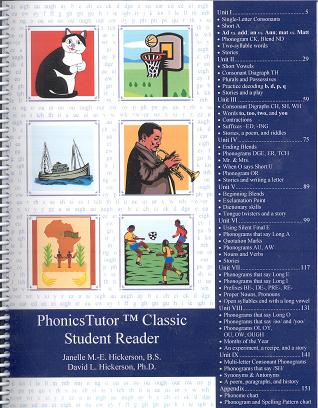
4:20 Communications, Inc. appreciates the wonderful
responses of students and teachers of the PT Student Reader
. Most students who complete the Phonics Tutor CD-ROM read at
a third-grade level or above. The vocabulary and spelling chart in
the
PT Student Reader will enable most students to read at a
fourth-grade level or above. It is 200 pages, 8 ½ x 11, spiral
bound, with laminated front and back. The
PhonicsTutor Student Reader
contains:
- A Phonics and Spelling Pattern Chart–
This detailed chart provides the additional phonics facts
that will enable students to become fluent, independent readers with
the skills to accurately decode almost any English word they will
encounter. Each phonogram or spelling pattern is followed by one of
its phonemes (indicated with diacritics); a list of the ten most
frequently used words that use that phonogram; a frequency
indicator; and a column listing the rules and observations about
that spelling pattern. The viewpoints of both Orton-Gillingham
Phonograms and The American Heritage Dictionary are included.
Comparisons are made between spelling patterns, e.g., "far" and
"large" vs. "various", "square", and "carried". Students and
teachers can easily see which spelling patterns are uncommon,
common, or very common. Readers will see that "ear" is not only
pronounced as "err" in words like "early" and "heard"; but most
often is pronounced as "ear" in words like "year" and "near"; and is
pronounced like "air" in "bear" and "wear".
- Expanded, random word lists–
Emphasis is given to derivatives, the most frequently used
words, and multi-syllabic words that use phonics facts already
presented. The 300 most frequently used words are flagged
throughout the book. A check mark indicates challenge words that
use familiar phonics facts in new, previously untaught
vocabulary. Three phonics tests are given at the end of Units
VI, VII, and IX.
- Controlled-vocabulary stories–
The "stories" include a play, poems, informative and/or humorous
paragraphs, dictionary pages, a science experiment, a recipe, a news
article, tongue twisters, riddles, and stories about both common and
uncommon events of interest to students of all ages.
-
Instruction on both phonics and beginning grammar–
Interspersed throughout the PT Student Reader are
pages which review spelling rules; provide additional rules on
syllabication and decoding examples; and introduce diacritics
similar to those used in The American Heritage Dictionary.
Prefixes, suffixes, and root words; subject/verb agreement;
comparative and superlative adjectives; nouns, proper nouns,
pronouns; singular, plural, first, second and third person verbs;
prepositions; homophones; synonyms and antonyms are all introduced
with many examples. An early introduction to the history of certain
spelling patterns helps students understand why English is the
largest language in the world.
|
|
|
For Teachers The scope and
sequence, goals, and special notes about the units in the PT Student
Reader are presented to instructors in two pages at the
beginning of each unit. On each student page in framed boxes,
instructions are directed to the student. Information about grammar,
spelling rules, or to set the stage for a story are included. Nothing
more is needed to teach a given page than what is on each page with few
exceptions. This format simplifies lesson planning for busy teachers and
increases ease of use for classroom volunteers, parents, or older
siblings.
|